 |
|||||
 |
 |
 |
|||
 |
|||||
 |
|||||
 |
|||||
 |
|||||
 |
|||||
 |
|||||
 |
|||||
 |
|||||
 |
|
|
|
|
|




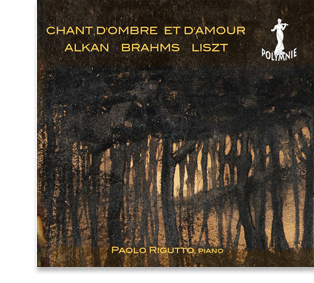
Chant d'ombre et d'amour
Alkan, Brahms, Liszt
Paolo
Rigutto, piano
POL 143 178



Franz Liszt
Die Loreley
Ballade n° 2 s171
Schumann-Liszt
Frühlingsnacht
Widmung Widmung
Charles-Valentin Alkan
Le Vent
Johannes Brahms
Quatre Ballades op. 10
Andante
Andante espressivo
Intermezzo
Andante con moto
Edouard Lassen - Liszt
Löse, Himmel, Meine seele
Richard Strauss
(arrangement Paolo Rigutto)
Morgen !
Liszt – Die Loreley
Deux légendes pour débuter ce chemin musical, avec tout d’abord
l’étrange et mélancolique Loreley.
Sur un rocher, surplombant le
Rhin, une belle jeune femme attire les marins par son chant avant
de les faire chavirer dans les profondeurs des eaux.
De nombreuses versions coexistent autour de ce personnage. Selon
l’une d’elles, presque sirène, elle attendrait le retour de son
amant qui l’a quittée, tandis qu’une autre évoque l’esprit d’une
femme qui aurait mis fin à ses jours par amour. Certaines enfin
racontent qu’il s’agit du fantôme de la Loreley, trompée et qui,
se rendant au cloître dans lequel elle a décidé de s’enfermer,
jette un dernier regard vers son château. Elle croit apercevoir le
bateau de son bien-aimé, vacille et tombe depuis le rocher dans le
fleuve...
Désespoir, charme, vengeance, douceur, tragédie... les sentiments
les plus contradictoires se mélangent dans une légende où
surnagent aussi bien l’amour que la trahison, le mystère que le
terrible, le calme et la profondeur du temps.
Liszt en compose une
première version pour chant et piano en 1841, qu’il choisit
ensuite de transcrire pour piano seul en 1844. Tout y est
représenté, le compositeur suivant le poème pas à pas. Le fleuve
s’y écoule, avec sa lenteur, hors du temps. Plus encore, il semble
être le temps lui-même, et nimbe de mystère cet endroit qui porte
un drame pour toujours.
Une tradition rattache, bien qu’il n’y ait pas de témoignage direct de Liszt à ce sujet, la Ballade n°2 au mythe de Héro et Léandre. Ce dernier est un jeune homme de la ville d’Abydos, qui se rend aux fêtes d’Aphrodite à Sestos, où il rencontre parmi les prêtresses la belle Héro. Le sacerdoce de celle-ci l’oblige à la virginité - la déesse ne pouvant tolérer une rivale - mais évidemment, dès le premier regard, un grand amour les saisit.
Séparés aussi bien par le détroit de l’Hellespont que par leurs destins opposés, c’est à la nage, chaque nuit, bravant tous les dangers de l’interdit divin et des courants marins, que Léandre rejoint Héro, qui le guide à l’aide d’une faible lanterne. Tous les soirs, dès le coucher du soleil, il effectue la dangereuse traversée, avec le printemps et l’été pour complices. Hélas, tout à leur amour, ils sont sourds à l’arrivée de l’hiver, ils ne s’aperçoivent pas que l’eau est toujours plus froide, la houle plus importante, les ombres plus présentes.
Un soir, la lanterne est constamment soufflée par la tempête, malgré tous les efforts de Héro pour en entretenir la flamme, et c’est désorienté, que Léandre finit par disparaître à tout jamais dans les eaux du détroit. Héro attend longtemps, en haut de sa tour, mais au petit matin elle aperçoit sur la rive le corps sans vie de son bien-aimé. Elle se jettera dans le vide pour le rejoindre dans l’au-delà, transcendant par cet acte un impossible et absolu amour, à l’image de Tristan et Yseult, Roméo et Juliette, ou encore Héloïse et Abélard qui verront le jour plus tard.
Les sources d’inspiration de la Ballade n°2 de Liszt sont diffuses et le compositeur n’en a pas laissé de trace écrite. Néanmoins, avec ses sourdes vagues, ses chorals lumineux, avec enfin cette funèbre mélodie transfigurée en un thème rayonnant, le mythe de Héro et Léandre n’est sans doute pas étranger à son propos.
Schumann-Liszt – Frühlingsnacht
Nuit de printemps pleine de promesses et d'espoirs, Frühlingsnacht, est une pièce pour voix et piano de Schumann, inspirée par un poème de J. von Eichendorff, tirée des Liederkreis op. 39.
Créée à partir de mai 1840, son "année du chant" (Liederjahr), cette œuvre est considérée comme l'un des grands cycles du romantisme, symbolique de cette époque dans sa façon de tisser des liens sensibles et intimes entre le poète et son environnement.
Il fallait le génie de Franz Liszt pour transcrire au piano tout ce monde de fraîcheur et de printemps naissant, sachant préserver les inflexions du chant dans un pianisme ingénieux et inspiré. D’ordinaire extrêmement fidèle au compositeur qu’il transcrit, Liszt choisit cependant ici d’ajouter une reprise au thème principal. Dans l’esprit d’une paraphrase, la deuxième partie le murmure à nouveau et semble alors donner la parole au monde de la nature, pour finir dans un élan de joie éclatante.
Schumann-Liszt – Widmung Widmung
Avec Widmung, c’est un extrait de Myrthen op. 25 que Liszt choisit
de transcrire, un cycle de lieder très variés, composé par
Schumann en 1840, au début de sa relation amoureuse avec Clara
Wieck.
Liszt se saisit de l’enthousiasme débordant de Schumann dans
Widmung, un hymne d’amour sur un poème de F. Rückert, au sein
d’ambiances poétiques et d’auteurs très différents (Goethe, Burns,
Byron, Heine, Moore...).
Il cède une fois encore à la tentation de paraphraser l’œuvre
originale et ajoute ainsi deux variations au thème, transcendant
le matériau initial, donnant à la force des sentiments exprimés
par le poème une dimension que Schumann n’aurait pas reniée.
Charles-Valentin Alkan – Le Vent
Figure de l’artiste romantique par excellence, doué, énigmatique,
contemporain et ami des Hugo, Liszt, Sand, Delacroix...
Charles-Valentin Alkan est aussi archétypal qu’insaisissable.
Promis à un avenir brillant, dans un siècle qui voit naître des
personnalités fondamentales pour l’histoire de l’art, il semble
tourner le dos aux salons parisiens de 1830 pour cultiver sa
singularité et concevoir une œuvre aussi subtile que brillante,
avant-gardiste.
Hallucinatoire et inspirée, diaboliquement virtuose, son écriture
s’ancre dans un certain classicisme dont elle casse les codes pour
proposer un discours novateur, à la dimension littéraire et
spirituelle. Dans Le Vent, extrait des Trois morceaux dans le
genre pathétique, composés en 1837, Alkan utilise un principe
simple : au dessus d’un choral lugubre, une gamme chromatique à
l’infini qui imite le bruissement d’un vent qui semble ne jamais
devoir s’arrêter. Alka
Un procédé d’écriture qu’il parvient à transfigurer dans une
texture qui tient du fantastique et n’a rien à envier aux
esthétiques modernes. Tantôt chuintant, fantomatique, sifflant,
ténébreux, ce tourbillon sonore, aussi tragique qu’il peut être
doux, ne s’apaisera qu’à la dernière note. En nous enveloppant
dans un flot de son, Alkan nous fait entendre ça et là, par
transparence, le thème de la 7e symphonie de Beethoven, comme une
ruine abandonnée, et préfigure le Finale de la Sonate funèbre de
Chopin.
Johannes Brahms – Quatre Ballades op.10
Lecteur passionné de légendes et de contes, Brahms livre avec les
Quatre Ballades op. 10 une œuvre narrative, sombre et profonde.
Son inspiration plonge ici ses ramifications dans un passé
lointain et mystérieux, celui des Reliques of ancient poetry, de
Thomas Percy (1765), un recueil de ballades et chansons dont la
plus célèbre, celle d’Edward, a motivé l’œuvre de Brahms.
Composées en 1854 - alors qu’il n’a que 21 ans - ces ballades
révèlent une maturité musicale et une inspiration puissantes. Si
Brahms se refuse à une musique à programme au sens strict, le
chant d’Edward sert néanmoins de support à la première d’entre
elles. Dans un style ossianique, tantôt sombre, rêveur, tantôt
chevauchée ou paysage, Brahms laisse ainsi à l’auditeur la liberté
de créer son histoire, ou de poursuivre celle d’Edward...
Edouard Lassen- Franz Liszt – Löse, Himmel,
Meine seele
Contemporain, assistant, puis finalement successeur de Franz Liszt
à Weimar, Eduard Lassen est un compositeur injustement méconnu.
Lauréat du prix de Rome en 1851, auteur de trois opéras, de
musiques de scène et de 260 lieder, figure culturelle reconnue en
Allemagne... l’avènement du nazisme en décidera autrement et le
plongera dans l’oubli.
Des trésors réapparaissent aujourd’hui, et
notamment grâce à Liszt qui a œuvré intensément pour promouvoir
son travail, assumant par exemple la production et
l’interprétation de son opéra Landgraf Ludwigs Brautfahrt, et
transcrivant nombre de ses lieder.
Parmi eux figure Löse, Himmel,
meine seele - transcrit en 1861 - Liszt ayant été touché par
l’intensité du poème de Peter Cornelius et la sincérité de
l’écriture de Lassen. Œuvre à la croisée de celles de Mahler ou de
Strauss, Löse, Himmel, meine seele se déploie avec une ardeur et
une sérénité qui transcende la poésie de P. Cornelius dans une
dimension toute spirituelle.
Richard Strauss - Morgen !
Morgen ! est le dernier des Quatre Lieder op. 27 composés par
Richard Strauss. C’est après sa rencontre avec John Henry Mackay à
Berlin que le compositeur mit en musique le poème de ce dernier,
le 21 mai 1894. Quelques mois plus tard il offrit les quatre
lieder en cadeau de mariage à sa femme, la soprano bavaroise
Pauline De Ahna. Transcrite pour violon et piano, puis pour
orchestre, cette œuvre a été composée initialement pour voix de
soprano et piano. C’est à partir de cette dernière version que je
l’ai arrangée pour piano seul. L’enjeu de cette transcription
était de conserver aussi intacte que possible la ligne du chant,
et de réaliser par le timbre les différents plans sonores.
L’écriture permettait de garder l’ensemble du matériau initial, et
je n’ai dû déplacer ça et là que quelques notes pour le rendre
réalisable. Enfin, les dernières mesures sont de l’ordre du
récitatif, et prennent beaucoup de sens avec le support du poème.
Ici point de paroles, mais cependant j’ai choisi de les laisser
telles quelles. En effet j’aime à imaginer la voix dans ce
passage, et lorsque je le joue, j’ai souvent le sentiment
d’entendre la chanteuse. Comme si finalement l’absence du texte la
rendait davantage présente, le jeu parlando prenant une dimension
toute autre et créant un instant d’une grande douceur. Ce chant
d’ombre et d’amour ne pouvait trouver une fin plus tendre.

Paolo Rigutto
Depuis toujours, Paolo Rigutto cherche à s’évader dans des
mondes artistiques puissants. Très inspiré par la littérature ou
la poésie, ses choix artistiques donnent souvent une place
importante à la narration et à l’onirisme. Chaque concert est
ainsi l’occasio pour lui de créer un chemin poétique qui fera
partager au public une expérience immersive dans un ailleurs
sonore.
Débutant le piano à l’âge de six ans, Paolo Rigutto se forme
auprès de Rena Shereshevskaya, puis du pianiste italien Fernando
Rossano. La rencontre avec Brigitte Engerer et Emmanuel Mercier
au CNSMDP sera déterminante pour lui. La culture du son, l’aura
de Neuhaus, de l’école russe ainsi que l’engagement artistique
total transmis par leur enseignement seront une profonde source
d’inspiration pour Paolo Rigutto. Encore aujourd’hui, la
générosité de Brigitte Engerer, son expérience de la scène et sa
présence artistique l’accompagnent dans son chemin musical.
En tant que soliste, Paolo Rigutto a été lancé par Brigitte
Engerer. Il a ainsi eu le bonheur de se voir invité dès ses
débuts en récital ou avec orchestre sur de grandes scènes comme
celle de Pianoscope, Lisztomanias ou Piano en Valois.
Depuis
lors, il poursuit sa carrière dans d’éminents festivals tels que
La Folle Journée de Nantes, La Roque d’Anthéron, Piano en
Valois, Piano aux Jacobins, Pianoscope, Lisztomania, Jeunes
talents, l’Opéra d’Avignon, Chopin à Paris, Esprit du piano,
Chopin à Nohant...tout comme à l'étranger comme (Chine qu’au
Japon, en Italie, en Espagne, Portugal, Suisse. etc.)
En parallèle de son activité de soliste, il forme avec la
pianiste Audrey Lonca-Alberto, le duo, Lonca-Alberto &
Rigutto. Couvrant une grande partie des œuvres pour quatre mains
ou deux pianos, leur répertoire s’exprime aussi dans des
transcriptions de pages orchestrales qu’ils affectionnent
particulièrement (Prélude à l’après-midi d’un faune,
Casse-noisette, Tableaux d’une exposition, Un Américain à
Paris...). Partenaires à la ville comme à la scène, ils
partagent depuis plusieurs années une réelle complicité
musicale. Une belle entente qui les a amenés à se produire dans
de nombreux festivals, en France et en Europe.
Depuis 2019, Paolo Rigutto est également membre du Trio Valadon,
en compagnie de Raquele Magalhaes (flûte) et d’Aurélienne
Brauner (violoncelle). Formation aussi rare que passionnante,
elle leur permet d’explorer des pans entiers du répertoire et de
participer activement à la scène musicale contemporaine. Ils ont
pu ainsi créer des œuvres de Richard Dubugnon, Pierre Farrago ou
encore Craig Bloomfield... A ce titre, il a eu l’opportunité de
faire la création mondiale d’Heathcliff - une œuvre pour deux
pianos de Philippe Hersant - dans le cadre du festival
Pianoscope en compagnie de Bruno Rigutto. Il est également le
dédicataire de Simple melody, une œuvre pour piano seul de
Christian Lauba.
Le disque Fragments d’âme avec la violoniste Sophie
Lemmonier-Wallez est sorti en 2022.
2024 sera également une
riche année discographique avec, outre Chant d’ombre et
d’amour,
un deuxième album sous le label Polymnie, en duo avec Audrey
Lonca-Alberto, consacré aux Poèmes symphoniques de Liszt.
Paolo Rigutto est lauréat de la Fondation Banque Populaire pour
la Musique.
Liszt
– Die Loreley
Two legendary tales set the stage for this musical adventure,
beginning with the mysterious and sorrowful figure of Loreley.
Residing on a cliff above the Rhine, this enchanting young woman
charms sailors with her haunting song, ultimately leading them
to a watery grave.
Loreley's character invites various
interpretations. In one version, she is seen as a mermaid,
patiently waiting for the return of her lost love. Another
narrative presents her as a woman who tragically took her own
life due to love's despair. Lastly, some view her as the ghost
of Loreley, who, betrayed and on her way to a convent for
solace, catches a glimpse of her lover's boat. In her moment of
distraction, she loses her balance and falls from the cliff into
the river below.
Despair, charm, revenge, sweetness, and tragedy – a tapestry of
conflicting emotions weaves through a narrative where love
intertwines with betrayal, mystery dances with horror, and
tranquility meets the passage of time.
In 1841, Liszt first
composed a version for voice and piano, later choosing to adapt
it for solo piano in 1844. Each element is carefully illustrated
as the composer reflects the story moment by moment. The river
flows on, symbolizing a timeless essence, almost personifying
time itself, shrouding this mysterious locale that holds an
everlasting drama.
Liszt – Ballade n. 2 s171
A tradition suggests a connection between the Ballade No. 2 and
the myth of Hero and Leander, despite the lack of direct
commentary from Liszt on the matter.
Leander is a young man from
Abydos who attends the rites of Aphrodite in Sestos, where he
encounters the enchanting Hero among the priestesses. Her role
demands her to remain a virgin, as the goddess cannot tolerate
any rivals. However, an overwhelming love blossoms between them
at first sight.
Separated by the Hellespont Strait and their differing fates,
Leander courageously swims to Hero each night, defying the
divine prohibition and battling the sea currents. Hero guides
him with a fragile lantern. Each evening, as the sun dips below
the horizon, he undertakes this perilous journey, with spring
and summer as his allies. Tragically, in their passionate love,
they ignore the arrival of winter, failing to notice the
increasingly frigid waters, the rising swells, and the
encroaching shadows.
One evening, a fierce storm extinguishes the lantern despite
Hero's desperate attempts to keep the flame alive. Disoriented
and exhausted, Leander ultimately vanishes into the depths of
the strait. Hero waits long atop her tower, but at dawn, she
sees her beloved's lifeless body washed ashore. In her grief,
she leaps into the abyss, joining him in the afterlife and
transcending their unattainable love, reminiscent of the tales
of Tristan and Isolde, Romeo and Juliet, or even Héloïse and
Abelard, who would be celebrated later.
While the sources of inspiration for Liszt's Ballade No. 2
remain elusive, the composer did not leave behind any written
clues. Nonetheless, with its somber waves, radiant chorales, and
a funeral melody transformed into a brilliant theme, the myth of
Hero and Leander undoubtedly plays a significant role in its
narrative.
Schumann-Liszt – Frühlingsnacht
"Spring Night, brimming with promises and hopes, known as
Frühlingsnacht, is a captivating composition for voice and piano
by Schumann. It draws inspiration from a poem by J. von
Eichendorff and is part of Liederkreis op. 39. Composed in May
1840, during his renowned 'year of song' (Liederjahr), this
piece is regarded as one of the remarkable cycles of
Romanticism, beautifully intertwining the poet's emotions with
their surroundings."
It was the brilliance of Franz Liszt that allowed him to
transcribe the essence of freshness and the awakening of spring
onto the piano, skillfully maintaining the nuances of the
original piece through his ingenious and inspired piano
technique. While Liszt is typically very loyal to the composer
he is interpreting, in this instance, he opts to incorporate a
reprise of the main theme. In a paraphrastic spirit, the second
section softly revisits it and seems to articulate the beauty of
the natural world, culminating in an explosion of radiant joy.
Schumann-Liszt – Widmung Widmung
With "Widmung," Liszt chose to transcribe an extract from
Myrthen, Op. 25, a collection of diverse lieder composed by
Schumann in 1840, at the beginning of his romantic relationship
with Clara Wieck.
In "Widmung," Liszt captures Schumann's
intense enthusiasm, presenting a love hymn inspired by a poem by
F. Rückert, while incorporating various poetic moods and authors
such as Goethe, Burns, Byron, Heine, and Moore. He once again
succumbs to the allure of reinterpreting the original work,
adding two variations to the theme. This transformation elevates
the emotional strength conveyed by the poem to a level that
Schumann would undoubtedly have appreciated.
Charles-Valentin Alkan –
Le Vent
Quintessential figure of the romantic artist, Charles-Valentin
Alkan was gifted, enigmatic, and innovative, befriending notable
figures such as Hugo, Liszt, Sand, and Delacroix. As archetypal
as he is elusive, he was destined for greatness in a century
that witnessed the emergence of pivotal personalities in the art
world. However, he appeared to turn away from the Parisian
salons of the 1830s to nurture his uniqueness and create a body
of work that was both subtle and brilliant, pushing the
boundaries of avant-garde.
Her writing is hallucinatory and inspired, showcasing a
diabolical virtuosity. It is rooted in a specific classicism,
which she skillfully disrupts to present a fresh discourse that
carries both literary and spiritual depth.
In "Le Vent," part of
"Three Pieces in the Genre of Pathétique," composed in 1837,
Alkan employs a straightforward principle: above a somber
chorale, an endless chromatic scale mimics the sound of a wind
that appears to never cease.
A composing process that he transforms into a fantastical
texture, rivaling modern aesthetics. At times eerie and ghostly,
this sonic whirlwind is both tragically beautiful and gently
haunting, only calming at its final note. By immersing us in a
torrent of sound, Alkan allows us to perceive, through a veil of
transparency, the echoes of Beethoven's 7th symphony,
reminiscent of a forsaken ruin, while foreshadowing the Finale
of Chopin's Funeral Sonata.
Johannes Brahms –
QuatreBallades op.10
As devoted admirer of legends and stories, Brahms presents a
profound narrative work in the Four Ballads, Op. 10. His
inspiration draws from a distant and enigmatic past,
specifically the "Reliques of Ancient Poetry" by Thomas Percy
(1765), which is a compilation of ballads and songs. The most
notable of these, the ballad of Edward, served as the catalyst
for Brahms' composition: Written in 1854 at the young age of 21,
these ballads showcase a remarkable level of musical maturity
and inspiration. While Brahms may reject program music in its
strictest form, Edward's singing provides a foundation for the
first ballad. With an Ossianic flair that oscillates between
dark and dreamy, as well as evoking images of riding or
landscapes, Brahms allows the listener the freedom to craft
their own narrative or to carry on Edward's story.
Edouard Lassen- Franz
Liszt – Release, heaven, my soul
Eduard Lassen, contemporary, assistant, and eventual successor
of Franz Liszt in Weimar, is an unfairly neglected composer.
Winning the Prix de Rome in 1851, composing three operas, and
more than 260 lieder, he established himself as a prominent
cultural figure in Germany. Unfortunately, the rise of Nazism
changed his fate, leading to his descent into obscurity. Today,
treasures are resurfacing, largely due to Liszt's efforts.
Indeed, he dedicated himself to promoting his work by producing
and performing his opera Landgraf Ludwigs Brautfahrt and
transcribing numerous lieder.
Among them is Lose, Himmel, meine seele - transcribed in 1861 -
Liszt having been touched by the intensity of Peter Cornelius'
poem and the sincerity of Lassen's writing. A work at the
crossroads of those of Mahler or Strauss, Lose, Himmel, meine
seele unfolds with an ardor and a serenity that transcends the
poetry of P. Cornelius in a completely spiritual dimension.
Richard Strauss (arrangement Paolo - Morning Rigutto) !
Morgen! is the final
piece of the Four Lieder op. 27, composed by Richard Strauss in
May 1894. After his encounter with John Henry Mackay in Berlin,
Strauss set Mackay's poems to music, which he later presented as
a wedding gift to his wife, the soprano Pauline De Ahna, just a
few months later.
Originally composed for soprano voice and
piano, this piece has been transcribed for violin and then for
orchestra. The current arrangement is based on this last
version. The main challenge was to preserve the integrity of the
song while exploring different sound layers through timbre. The
composition allowed for the retention of all original material,
needing only minor adjustments of a few notes for practical
purposes. The final measures take on a recitative quality and
gain significant meaning with the poem's support. However, they
are presented here in their original form, with the absence of
text in this album offering a completely different perspective
and enabling soft moments of suspension. This song, embodying
themes of shadow and love, could not have a more tender
conclusion.
Paolo
Rigutto
Paolo Rigutto has consistently aimed to immerse himself in
captivating artistic realms. Deeply influenced by literature and
poetry, his artistic selections frequently emphasize narrative
and a dreamlike quality. Consequently, each concert serves as a
chance for him to craft a poetic journey, inviting the audience
to partake in an immersive experience that transports them to a
different sonic dimension.
Paolo Rigutto began his piano journey at the age of six,
training initially with Rena Shereshevskaya and later with the
Italian pianist Fernando Rossano. Hailing from the prestigious
Santa Cecilia school in Rome, Rossano instilled in him a deep
love for Mozart and an unquenchable curiosity for music
A
pivotal moment in Paolo Rigutto's development came when he met
Brigitte Engerer and Emmanuel Mercier at the CNSMDP. Their
teachings, enriched by a profound understanding of sound, the
influence of Neuhaus, and the dedication of the Russian school,
served as a significant source of inspiration for him. Even now,
the generosity, stage presence, and artistic spirit of Brigitte
Engerer continue to guide him on his musical path.
As a soloist, Paolo Rigutto was introduced by Brigitte Engerer.
This opportunity allowed him to perform on prestigious stages
from his debut, whether in recitals or with orchestras,
including events like Pianoscope, Lisztomanias, and Piano en
Valois.
Since then, Paolo Rigutto has furthered his career at
renowned festivals such as La Folle Journée in Nantes, La Roque
d'Anthéron, Piano en Valois, Piano aux Jacobins, Pianoscope,
Lisztomania, Jeunes Talents, Opéra d'Avignon, Chopin in Paris,
Esprit du Piano, and Chopin in Nohant.
His international presence includes performances in countries
like China, Japan, Italy, Spain, Portugal, and Switzerland.
Additionally, he regularly records for radio stations such as
France Musique, Radio Classique, and France Bleu.
Alongside his solo career, Paolo Rigutto has consistently
nurtured a passion for chamber music. Currently, he collaborates
with pianist Audrey Lonca- Alberto to form the duo Lonca-Alberto
& Rigutto. Their repertoire encompasses a wide range of
works for four hands or two pianos, including cherished
transcriptions of orchestral pieces such as Prelude to the
Afternoon of a Faun, Casse-noisette, Tableaux d'une exposition,
and An American in Paris. As partners both in the city and on
stage, they have developed a strong musical connection over the
years, performing at numerous festivals throughout France and
Europe.
Since 2019,
Paolo Rigutto has also been a member of the Valadon Trio,
alongside Raquele Magalhaes (flute) and Aurélienne Brauner
(cello). This unique and thrilling ensemble allows them to delve
into extensive sections of the repertoire while actively
engaging with contemporary music. They have had the opportunity
to premiere works by composers such as Richard Dubugnon, Pierre
Farrago, and Craig Bloomfield. Creation
With a strong interest in contemporary music and a desire to
promote it, he frequently collaborates with modern composers
like Craig Bloomfield, Richard Dubugnon, Pierre Farrago, and
Bruno Mantovani. One notable achievement was performing the
world premiere of "Heathcliff," a composition for two pianos by
Philippe Hersant, during the Pianoscope festival alongside Bruno
Rigutto. Additionally, he is honored to be the dedicatee of
"Simple Melody," a solo piano piece by Christian Lauba.
Recordings
The album "Fragments d'âme," featuring violinist
Sophie Lemmonier-Wallez, was released
“Ihinav2e0n2o2d.oTubhteaybeouatrh2is0b2e4auptrifouml
isestobeanotherfruitfulyearforrecordings,withthe upcoming "Chant
d'ombre et d'amour" and a second album under the Polymnie label,
in
artistic nature and his future as a
collaboration with Audrey
Lonca-Alberto, focusing on Liszt's symphonic poems.
talented
pianist”
Paolo Rigutto has been recognized as a laureate of the
Banque Populaire Foundation for
Music.
Accueil | Catalogue
| Interprètes | Instruments
| Compositeurs | CDpac
| Stages | Contact
| Liens
• www.polymnie.net
Site officiel du Label Polymnie • © CDpac • Tous droits
réservés •